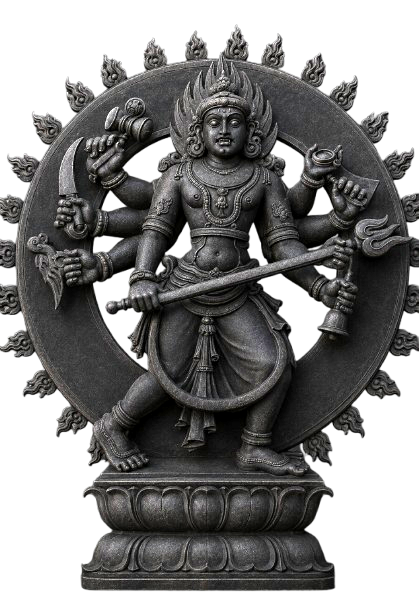
Presiding Deity

Sri Kāla Bhairavar

The Temple of Kāla Bhairavar - A Monument to Time, Consciousness, and Cosmic Order.

Phase II project work - main sanctum
Sri Kāla Bhairavar

Introduction

With the Grace and Blessings of Shaktha Maha Guru Shreem Maheshji Swamiji, this sacred temple is being envisioned as a unique spiritual monument dedicated to Sri Kāla Bhairavar, the Lord of Time, and the Aṣṭa Bhairavars, the Eight Cosmic Guardians who govern the directions, dimensions, and cycles of existence.

While temples traditionally serve as places of worship, this temple has been conceived as something deeper - a living reminder of humanity's relationship with Time itself. It is a sacred space where ancient spiritual wisdom and modern scientific understanding converge around one profound truth.

Everything in existence is governed by Time. Every birth, every transformation, every thought, every civilization, every star, and every galaxy unfolds within the framework of Time. In the language of Sanatana Dharma, this governing principle is known as Kāla. In this temple, Kāla is worshipped in the form of Sri Kāla Bhairavar.

Kāla Bhairavar in the Traditional Spiritual Understanding

In the Shaiva and Shakta traditions, Kāla Bhairavar is one of the most powerful manifestations of Lord Shiva. The name itself carries profound meaning:

  • Kāla - Time
  • Bhairavar - The One Beyond Fear, the Terrifying Dissolver of Ignorance

Kāla Bhairavar is not merely a deity associated with timekeeping or death. He is Time itself. He represents the unstoppable force that governs creation, sustenance, transformation, decay, and dissolution.

Kings surrender to Time. Empires surrender to Time. Stars surrender to Time. Even gods operate within Time. Kāla Bhairavar stands as the eternal witness to all cycles of existence.

For this reason, he is revered as:

  • Guardian of Dharma
  • Lord of Karma
  • Protector of Sacred Spaces
  • Keeper of Cosmic Order
  • Controller of Birth and Death
  • Master of Destiny and Timing

In many traditions, devotees seek the blessings of Kāla Bhairavar to overcome fear, obstacles, delays, confusion, and karmic limitations.

Kāla Bhairavar in the Scientific Understanding

Modern science has arrived at a remarkable realization. Time is not merely a clock. Time is a dimension.

According to Einstein's theory of relativity, reality is not made of space alone but of Space-Time. Every event that occurs in the universe is defined by where it occurs (Space) and when it occurs (Time).

Without Time, the universe would be frozen. There would be no movement, no growth, no evolution, no cause and effect. Time is the invisible framework upon which reality unfolds.

In this understanding, Time is not something inside the universe. Time is one of the fundamental properties that make the universe possible.

The ancients expressed this same truth through the symbolism of Kāla Bhairavar. What science describes mathematically as Time and Space-Time, spiritual traditions personified as a divine principle worthy of reverence and contemplation. Thus, Kāla Bhairavar represents not merely mythology, but one of humanity's deepest attempts to understand the fundamental structure of reality.

The Aṣṭa Bhairavars - The Eight Dimensions of Time

Surrounding the central shrine of Kāla Bhairavar are the Aṣṭa Bhairavars - the Eight Manifestations of Bhairavar. These eight forms govern the eight cardinal and inter-cardinal directions of space.

Spiritually, they are the guardians of the universe. Symbolically, they represent the many ways through which Time expresses itself within creation. Just as one sun illuminates the world through many rays, one Kāla Bhairavar manifests through eight cosmic functions.

  1. 01 · East

    Asitāṅga Bhairavar

    Beginnings, emergence, and awakening

    Represents sunrise, birth, knowledge, and the start of all journeys.

  2. 02 · Southeast

    Ruru Bhairavar

    Wisdom and guidance

    Represents learning, refinement, discipline, and spiritual evolution.

  3. 03 · South

    Caṇḍa Bhairavar

    Courage and decisive action

    Represents transformation through effort and determination.

  4. 04 · Southwest

    Krodha Bhairavar

    Purification

    Represents the destruction of negativity, ignorance, and stagnation.

  5. 05 · West

    Unmatta Bhairavar

    Transcending limitations

    Represents spiritual freedom and expansion beyond ordinary perception.

  6. 06 · Northwest

    Kapāla Bhairavar

    Impermanence

    Represents mortality, humility, and the understanding that all forms are temporary.

  7. 07 · North

    Bhīṣaṇa Bhairavar

    Protection and vigilance

    Represents stability, strength, and guardianship of sacred principles.

  8. 08 · Northeast

    Saṃhāra Bhairavar

    Dissolution and liberation

    Represents the return of all existence into its source and the transcendence of time itself.

Why the Temple Is Designed Around the Eight Directions

The temple architecture itself reflects a profound cosmic principle. Human beings naturally experience reality through directions: East, West, North, South, and the spaces between them.

Ancient spiritual traditions recognized that existence unfolds not only through space but through ordered cycles and movements. The eight Bhairavars positioned around the temple symbolize the complete governance of Time throughout all dimensions of existence.

The devotee standing at the center becomes a symbolic participant in the cosmic mandala. Surrounded by the eight Bhairavars and facing Kāla Bhairavar, one is reminded that every journey in life unfolds within the framework of Time.

Time as the Ultimate Controller

Human beings often believe they control their lives. Yet Time remains the great equalizer.

Time transforms a child into an elder. Time turns seeds into forests. Time builds mountains and erodes them. Time creates civilizations and returns them to dust.

Every experience is measured by Time. Every achievement exists within Time. Every spiritual journey unfolds through Time.

For this reason, the temple is conceived as a monument to the supreme reality that governs all beings. The worship of Kāla Bhairavar is ultimately the recognition that Time is not an enemy to be feared but a sacred force to be understood.

When one aligns with Time, one aligns with Dharma. When one aligns with Dharma, one aligns with the cosmic order.

The Vision of the Temple

This temple is envisioned as more than a religious structure. It is a spiritual, philosophical, and educational monument that invites visitors to contemplate one of the deepest mysteries of existence.

It stands at the intersection of:

  • Spirituality and Science
  • Tradition and Modern Understanding
  • Space and Time
  • Matter and Consciousness

At its center stands Sri Kāla Bhairavar, the Lord of Time. Around him stand the Aṣṭa Bhairavars, the guardians of the cosmic directions. Together they remind humanity of an eternal truth:

Time governs all things, yet through wisdom, devotion, and self-realization, one may transcend the limitations of Time and discover the timeless reality that lies beyond it.